About
How a philosophy degree turned into causal inference at a tech company.
I’m a Senior Applied Scientist at Zalando, working on causal inference - first in marketing science (does advertising work, and how would you know?), now in pricing science (what is the right price, and how would you know?).
The path here was not a straight line.
Oxford and Barcelona

I read Philosophy, Politics and Economics at Oxford. Economics is the part that stayed with me: it asked the same questions as the philosophers, but insisted on answers that could be checked against data. I have been looking for that combination - a question worth asking and an answer you can verify - in every job since.
A PhD in Development Economics and Applied Microeconomics at Universitat Pompeu Fabra came next. I was supervised by Alessandro Tarozzi and Robin Hogarth and spent time as a Marie-Curie Fellow at the École Normale Supérieure/Paris School of Economics. Five years of applied research, including on projects in Sierra Leone and Ghana, taught me how hard it is to say that X causes Y and mean it.
Dakar and Northern Nigeria

Development economics led to development practice. At IDinsight in Dakar, Senegal, I was technical lead on randomised controlled trials across West Africa. The largest was an evaluation of New Incentives, a programme paying small cash incentives for infant vaccination in Northern Nigeria: 200 enumerators, 1000s of caregivers, and daily puzzles such as how to draw a random sample where no sampling frame exists. On the strength of that evaluation, GiveWell named New Incentives a top charity in 2020 and has since directed over $130 million to the programme. It is still the work I am the most proud of.
Berlin

COVID then stopped fieldwork almost everywhere, and much of the work I cared about moved into government. At IDinsight I had worked with governments from the outside, and I was curious what the same problems looked like from the inside. I joined the German Federal Ministry of Finance, where I designed the €2.5 billion Sonderfonds des Bundes für Kulturveranstaltungen, the federal backstop that made it possible to plan concerts and festivals under pandemic uncertainty, and then moved to the Chancellery to roll it out with the sixteen Länder. As the crisis waned I worked on the ministry’s fiscal-policy strategy, helped prepare OECD and IMF missions to Germany, and organised conferences bringing academic economists into the ministry, among them the Franco-German Fiscal Policy Seminar.
Back to data
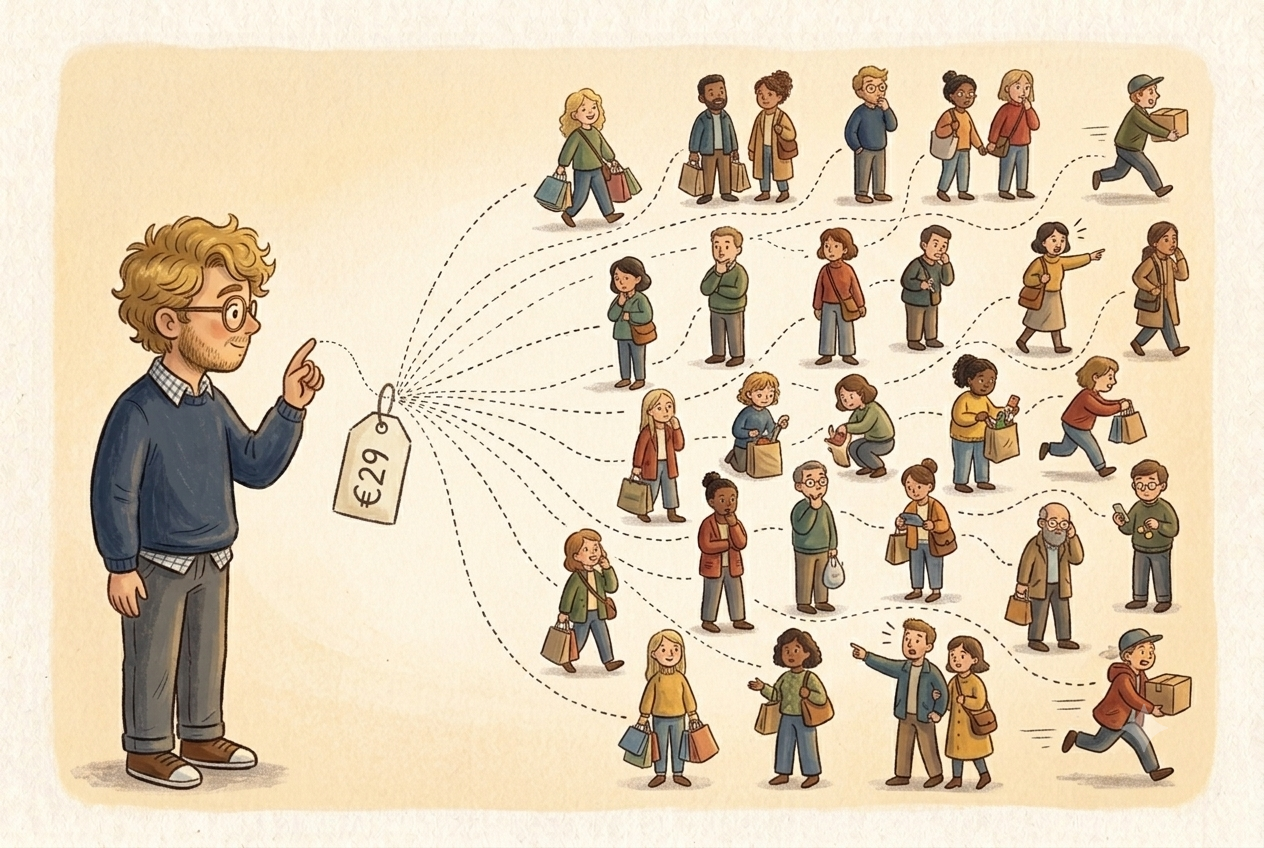
After three and a half years I wanted to go back to doing the analysis myself. I had already drifted toward the data end of government, with stints in the Ministry of Finance’s Digitalisation unit, and I was looking for problems where the analysis is the main work rather than one input among many. A tech company was the natural next step, and Zalando, which runs experiments at a scale that is rare outside a handful of companies, was an easy choice.
This blog
I write here about causal inference and machine learning, mostly about things I had to work out for myself and could not find explained clearly elsewhere. Writing is how I learn them properly. The posts assume a technical reader, but not a specialist in causal inference.
If something here is useful, or if you think I have got something wrong, I would like to hear about it: LinkedIn · GitHub